01
Watch the Buds Open on Day Two
Stems land shut and reach full spread by the third morning, which adds 2 to 3 vase days over a bouquet that opened inside the truck.
Sending flowers you will never see before they land? Blooms2Door cuts stems on the farm the day they ship, rated 3.9 by 1,274 verified buyers.
Farm-cut stems, a noon order cutoff, and 1,274 verified reviews: the reasons buyers picked these bouquets over a local florist run.
Stems land shut and reach full spread by the third morning, which adds 2 to 3 vase days over a bouquet that opened inside the truck.

Fifty rose stems ship straight from the harvest bench at wholesale count, not a retail dozen wrapped in cellophane at a storefront.
Cut-to-order harvest skips the wholesale cooler entirely, so the rose in your recipient's hand left the field the previous day.
Tick the gift box at checkout and your typed message travels in the same 6-inch carton, at no extra charge on any bouquet.
The 50-stem tulip bouquet carries 722 verified buyer reviews, the widest sample in the range and the most externally checked listing.
Pick red roses for an anniversary or white orchids for a sympathy send, and every color travels under the same overnight label.
Roses, orchids, sunflowers, and tulips leave the same farm bench, in bouquets running from 10 stems up to 100.
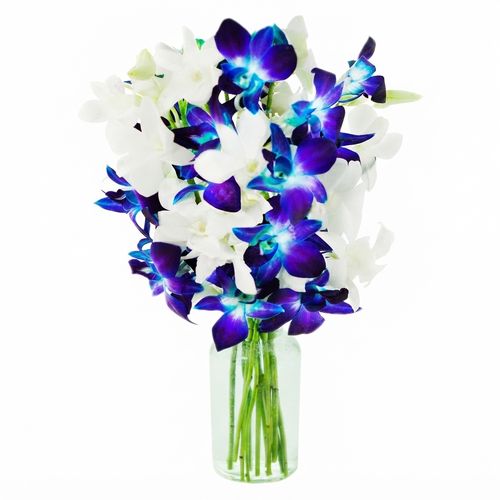
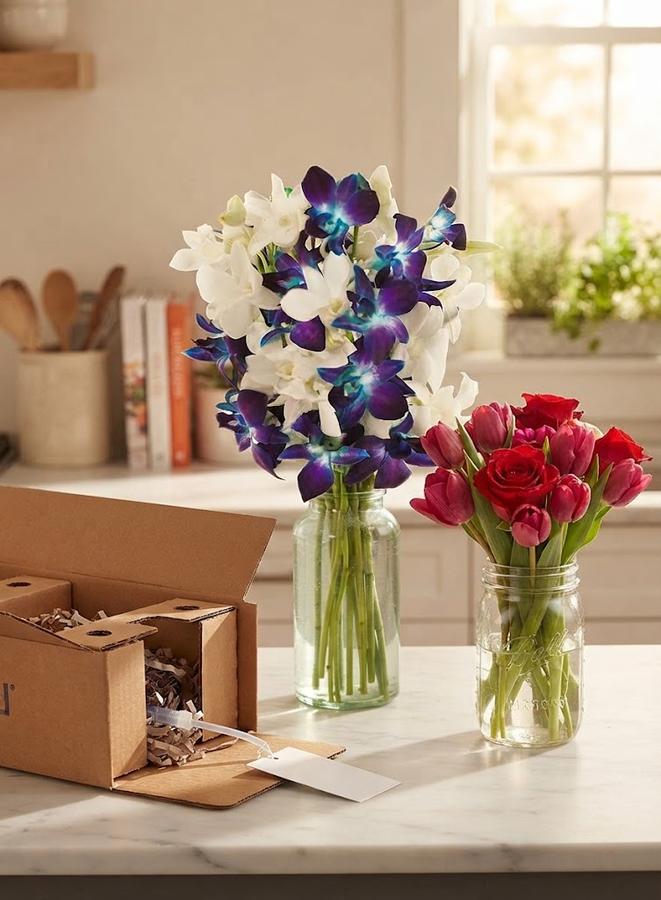
Five blue and five white orchid stems arrive already standing in their own glass vase, so nobody in the house hunts under a sink for a container on a difficult morning. Dendrobium petals hold a waxy skin that gives up water slowly, so the vase still shows blue on day five in a heated apartment. Where a boxed loose-stem bouquet needs someone with a vase and ten spare minutes, this one is set down and finished. The 5 lb box ships entry-level, rated 4.2 stars across 26 verified reviews, and a cracked vase goes back through the retailer's return window the same week.
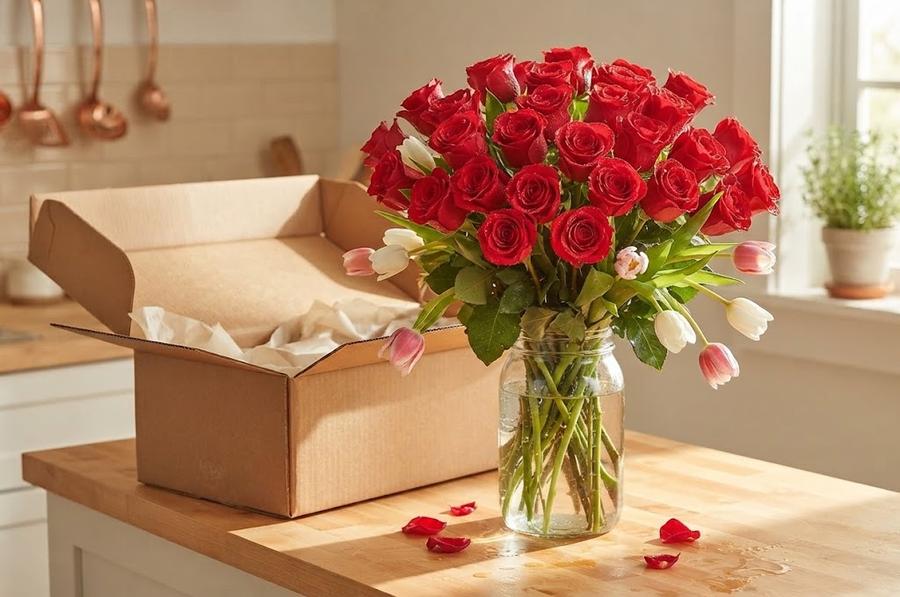
Fifty red rose stems land closed and green-tipped, which reads as a mistake until the second morning when the first heads crack open. Cut an inch off each stem at a slant within the first hour, because a flat cut seals against the jar bottom and the rose stops drinking on day one. Where a florist bouquet arrives at full spread and starts declining that evening, these spend days two and three opening on the counter. The bundle ships at 10.5 lbs, a genuine armful, and carries 3.6 stars across 26 verified reviews. Order two days ahead of the occasion, not the morning of.
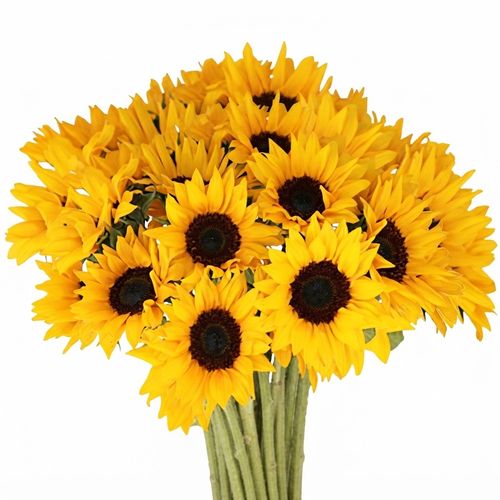
Fifty sunflower stems fill four or five jars around a single room, which is a different job from a bouquet meant for one table. Sunflowers drink harder than any other stem here and will empty a jar within two days, so top the water up rather than waiting for the scheduled change. Where a florist sells you a dozen in a wrap, buying the bundle lets you break it across a kitchen island, a hallway table, and a porch step. The carton ships at 8 lbs and holds 3.4 stars across 23 verified reviews, the range's most divided listing on head size.
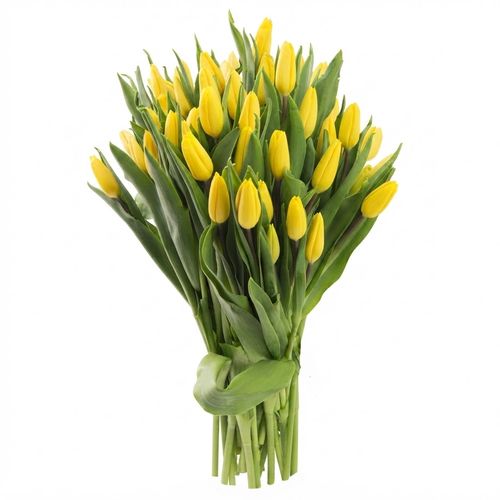
Seven hundred and twenty-two verified reviews sit behind this tulip bundle, more than any other listing here, which makes it the sensible first boxed order for a skeptical sender. At 3.5 lbs it is also the lightest carton in the range, easy to carry from a porch to a third-floor apartment in one trip. Tulips show the process plainly: closed on arrival, cracked open the next morning, full spread by the third day. They also keep growing in the jar and lean toward the window, so turn the vase each morning. Rated 4.0 stars, with replacement through the retailer for a damaged arrival.
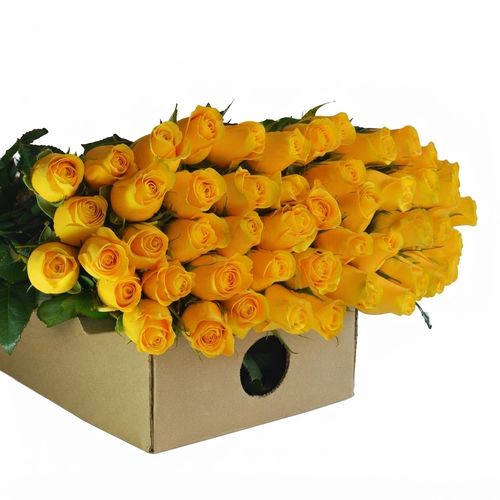
Long-stem yellow roses cut at 50cm give you height to work with, enough to fill a tall floor vase without propping the heads on the rim. Farm-cut roses still carry thorns, so strip the lower stems with a cloth before you arrange, particularly if a child helps. Where a supermarket bunch arrives already open and short, these land closed on 50cm stems and give you the length to trim twice across the week. The bundle ships at 10.5 lbs and shows 3.9 stars across 11 verified reviews, a thin sample worth reading as an early signal rather than a settled verdict.
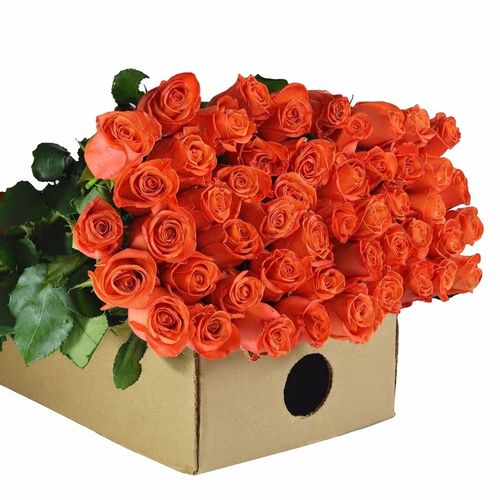
Orange roses on 50cm stems sit in the Wedding Collection slot, aimed at a table run rather than a single bedside vase. Fifty stems cover four reception tables at a dozen each, with heads left over for a cake table or a welcome sign. At 5 lbs the carton is half the weight of the red rose bundle, so one person carries it into a venue without a trolley. Review volume here is a single entry, too thin to read as a verdict, so judge it on the stem length and count instead. Arrivals damaged in transit route back through the retailer.
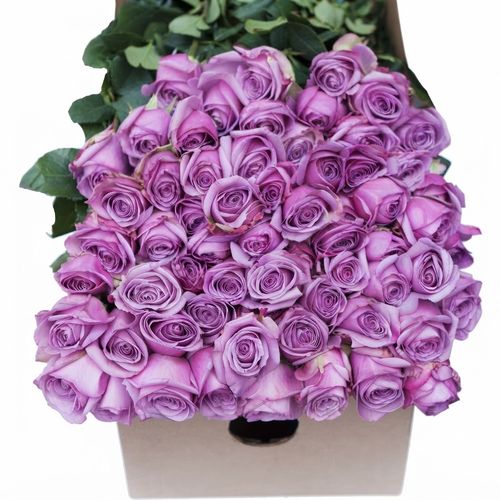
One hundred purple rose stems arrive in a single 10 lb carton the afternoon before a wedding, and that is the whole point of the flagship count. Split across eight reception tables, each still holds a full dozen, and what remains covers a cake table and two bathroom counters. Buy by stem count and you fill your own jars on the Friday before, instead of accepting the jar a florist chose from a set photo. Deep purple still reads purple under reception hall bulbs after 8pm, where pale pink drifts toward white in every photograph. Rated 3.9 stars across 464 verified reviews, enough write-ups to scan in one evening before you commit a table plan.
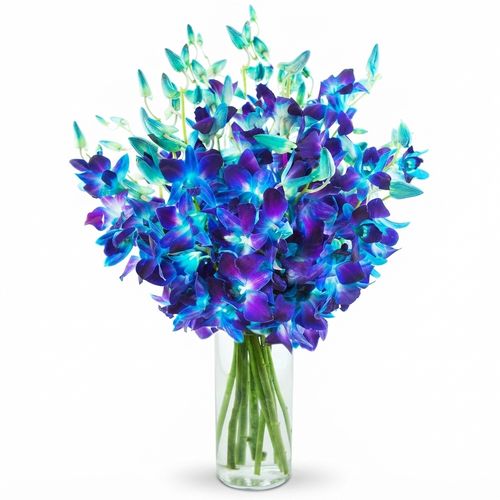
Twenty blue dendrobium stems travel standing upright in a 27.5-inch tall carton, square at the base, so the glass vase never rolls onto its side and snaps stems in transit. That packing choice is why this arrangement can be lifted straight from the box onto a table with no arranging at all. Lift the vase out on delivery morning and the blue is already dye-fed through each stem, holding for the full vase life of the cut flowers. At 4 lbs the whole box comes off the porch with one hand, the lightest vase arrangement in the range. A single review sits behind this arrangement, too thin to weigh, so judge it by the packing spec you can read in a minute.
Blooms2Door prints carton weight, box height, and blackout weekdays on the shipping label, so you can clear a shelf before the box lands.
| The number | What it means on your porch | Source |
|---|---|---|
| 12PM EST, Mon-Thu | Click order at 11:50 on a Wednesday morning and the stems leave the farm that afternoon. Click at 12:30 and the carton waits for Thursday. Open three other flower-delivery pages the night before an anniversary and each one tells you to order early without naming an hour. Blooms2Door prints the shut weekdays beside the clock, so you count backwards on a calendar instead of guessing at checkout. |
stated delivery policy |
| No Sat, Sun, or Mon delivery | Order on a Friday for a Saturday anniversary and the carton does not move until Tuesday, because the closed stretch runs three days end to end. Buyers reach checkout on a Friday afternoon asking one thing: will this box land before Saturday's party? Few pages name the shut days, so you find out when the tracking number sits unmoved for three mornings. |
stated delivery policy |
| 2-3 extra vase days | A rose that travels closed spends its opening days on your recipient's counter instead of in a cargo hold, worth 2 to 3 more days in the jar. Every flower page promises long vase life, and you cannot test that promise until day six on your own counter. Ask why and most pages go quiet; here the extra days trace back to a bud cut before dawn on shipping day. |
manufacturer spec |
| 3.9 stars / 1,274 reviews | Buyers rate these bouquets 3.9 stars over 1,274 verified purchases, a sample wide enough that one rough Valentine's week does not set the average on its own. Tap the star icon on a smaller flower page and no count opens behind it, so a 5.0 rating may rest on four buyers. |
1,274 verified buyer reviews |
| 5 lbs to 10.5 lbs | Move from the 10-stem orchid vase to the 50-stem red rose bundle and carton weight climbs from 5 lbs to 10.5 lbs of actual stem and water. Click a size dropdown on most flower pages and 50 stems and 20 stems look identical on screen, with no shipping weight beside either. Lift the bigger carton off the porch and the difference registers in your arms before the tape comes off. |
product shipping spec |
| 27.5 x 6.5 x 6.5 in | The 20-stem blue orchid travels standing upright in a tall 27.5-inch carton, square at the base, so the glass vase never rolls onto its side in transit. Measure a hallway console before ordering and most flower pages leave you guessing, offering a styled photograph instead of a box height. A photograph cannot tell you whether the carton clears an apartment mail room slot on delivery morning. |
product packaging spec |
A Blooms2Door carton has to survive the truck, the occasion color, the table size, and the first hour after it lands.
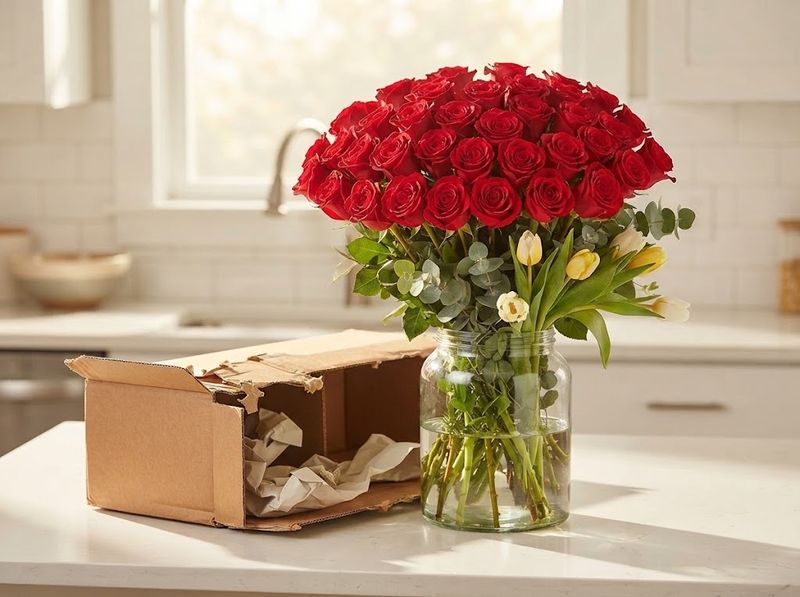
Open a Blooms2Door carton and the roses look half finished: tight green-tipped buds with no open petal in sight. That closed head is what survives a night of cargo air and a cold porch. An open bloom bruises against the liner in the same trip. Set the stems in water that evening and the petals break by the second morning.
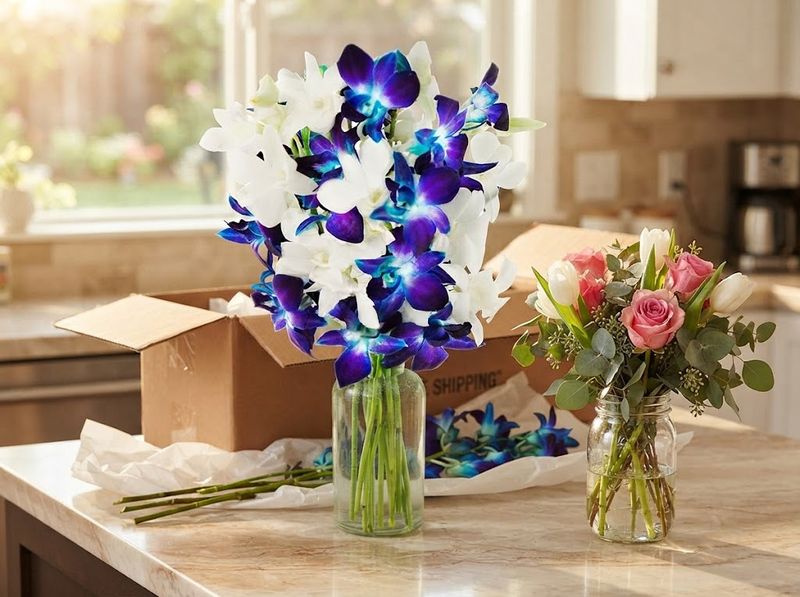
Color carries the message before your note is read, which is why 50 red roses and a white orchid vase are never interchangeable sends. Send 50 red roses for an anniversary and nobody misreads it. A sympathy delivery reads better in white orchid, and the 10-stem blue and white orchid arrangement lands in its own glass vase, so the household never hunts for one on a hard day. Purple roses cover the wedding table run.
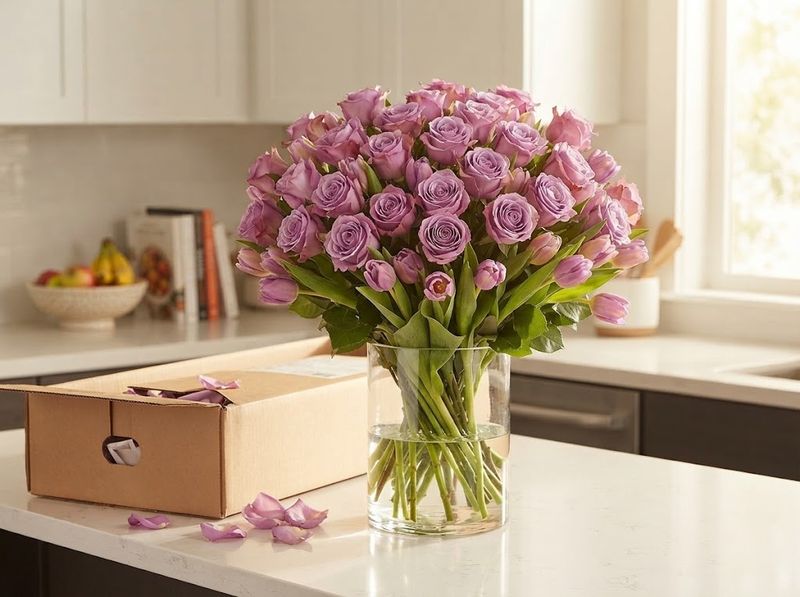
Stem count decides which room the bouquet fills, not the photograph on the listing, and the gap between 10 stems and 100 is a different job entirely. The 10-stem orchid vase occupies a nightstand corner and still leaves space for a lamp and a phone. The 100-stem purple rose bouquet is a different job: split it across eight dinner tables for a wedding and each one carries a dozen stems with heads left over for the cake table.
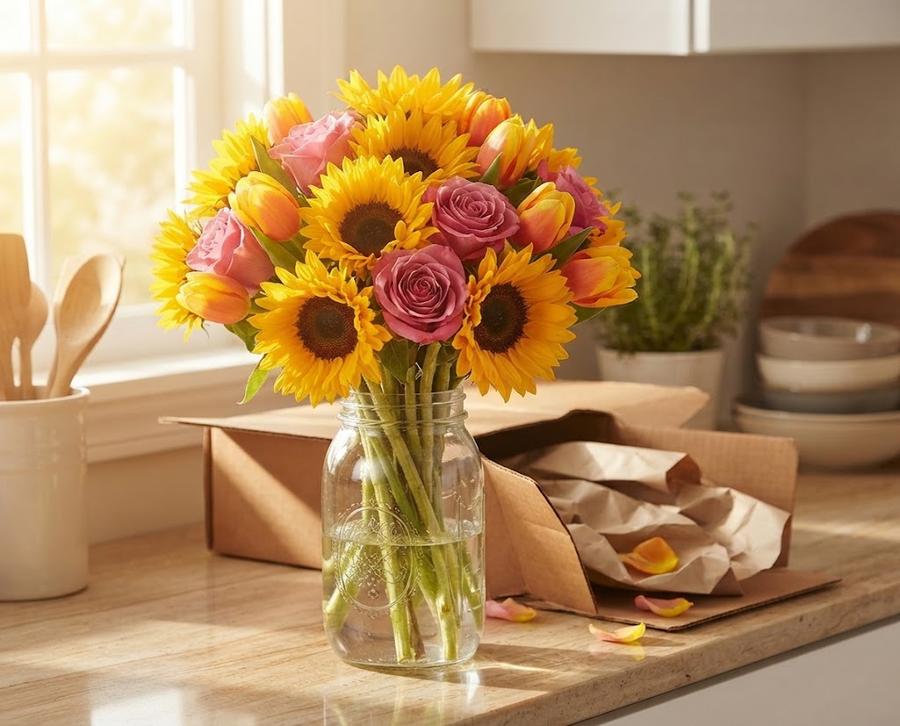
Cut 1 inch off every stem at a slant within an hour of opening the box and the bouquet gains days. A flat cut seals against the bottom of the jar and the stem drinks nothing. Fill with cool water, keep the vase off a sunny windowsill, and change the water every second morning. Sunflowers drink hardest and empty a jar fastest.
You order stems you will never inspect yourself. The farm cuts them the morning the box leaves, packs them closed, and hands the carton to an overnight carrier. Your recipient opens tight buds, trims the ends, and watches the petals unfold across the next two mornings. A gift note you type at checkout rides inside the same box.
Some Blooms2Door reviews describe roses that came out of the box black-edged and never opened past day three, and that is the honest place to start. Sort those 1,274 reviews by calendar week and one stretch of February accounts for most of the bad cartons. Order into a quiet Tuesday and your box makes a single overnight hop.
Order into the Valentine's Day crush and it can sit an extra day in a carrier hub, opening late. You are buying wholesale bulk flower bouquets online, cut on the farm bench the morning they ship, not pulled from a florist cooler. A bud-stage rose rides an overnight truck run intact while an open bloom sheds petals against the liner, which is why your stems arrive shut.
Your carton ships out of the KaBloom storefront that grows and fulfills the bouquets, so one operation handles the stems from bench to porch. If your box lands wilted, photograph it the same day and file a replacement through the retailer. The standard return window covers a perishable arrival, so you file once with photos instead of chasing a separate brand guarantee for weeks. Order a day ahead of your noon cutoff and you keep a buffer against the Saturday, Sunday, and Monday blackout.
Read the full brand story
Blooms2Door cuts and tapes your carton inside one business day, then leaves you a two-minute trim-and-water routine when the box lands.
Choose 10 stems for a nightstand gift or 100 for a wedding table run.
Place the order before 12PM EST Monday through Thursday and the stems leave the bench that same afternoon.
Follow the 6-inch carton overnight on the tracking page, and expect no movement across Saturday, Sunday, or Monday.
Cut the stems at an angle under running water within an hour of opening, then keep the jar off a sunny sill.
Two-week vases, a February batch that arrived black-edged, and a birthday card that never made it into the box.
Ordered these on a Wednesday for our anniversary and the box was on the porch by ten the next morning. Every head was shut tight, which worried me for about an hour until I read the card in the box. Trimmed them at an angle, stuck them in a pitcher, and by Friday breakfast half of them had cracked open. Saturday they were full. Fifty stems filled three vases with a few left over for the kitchen window.
I ordered for Valentine's Day and that was the mistake. The box sat somewhere an extra day and when it landed the outer petals were browning at the edges. Maybe a dozen of the fifty opened properly. I sent photos the same afternoon and got it sorted through the retailer without much argument, so the resolution was fine. Next time I am ordering in a quiet week instead of the busiest flower week of the year.
Second time ordering the yellow tulips. They arrive closed and lying flat in the box, which looks alarming if you have not seen it before. Cut, water, and they stand up within a couple of hours. Mine leaned hard toward the window overnight so I turned the jar each morning. Still good on day nine. The carton is light enough that my mother carried it upstairs herself, which mattered more than I expected.
Flowers were lovely and my sister said they lasted almost two weeks. The problem was the card. I typed a message at checkout but never ticked the gift box, so nothing printed and she had no idea who sent them until I called. That is on me, but I would have liked a louder prompt in the cart. Ordering again, with a screenshot of the confirmation this time.
Sent these to a friend after a funeral. The vase arrives in the box with the stems already standing in it, so nobody in that house had to go hunting for something to put them in on a hard morning. She sent me a photo two weeks later and they were still holding color. That is the whole reason I picked them over a loose bunch of stems in a sleeve.
Fifty sunflowers for a fiftieth birthday. About six heads arrived bent or broken, which I half expected with that many stems packed into one carton. The rest were fine and they drank water faster than anything I have kept in a vase. I was topping the jars up every other day. Good for filling a room, less good if you need every single stem presentable in a photograph.
Bought a hundred purple roses for our daughter's reception. One carton, heavier than it looks, delivered Friday afternoon. Two of us stripped thorns and filled the jars in a bit over an hour that evening. By Saturday morning every head was open for the photographs, which is exactly what we were hoping for. A florist would have handed us finished arrangements; doing it ourselves let us decide which tables got flowers.
The blue is dye rather than a grown color, and I did not work that out until the stems were on my counter. They looked striking for the whole vase life, so no complaint about how they held up. But I had planned to pot them afterwards and expected the same shade next season, and that is not how it works. Read the description more carefully than I did.
What happens between the overnight carton on the porch on Day 1 and the last tulip going soft around day 10.
The carton lands before lunch. Slit the tape, lift the sleeve of stems out of the sleeve liner, and get them standing in water inside the hour. Check the heads while the box is still open: crushed or brown edges qualify for a replacement through the retailer, and the return window runs from this day.
The first buds crack by the second breakfast and the bouquet reaches full spread on day three. Swap the water on the morning of day two, before the jar clouds. Tulips lean toward the window overnight and need turning; roses hold their shape and stay where you set them.
Tulip stems soften first, usually somewhere in the second week, while roses keep petal edges longer in a cool room. Pull the drooping stems, re-trim what is left, and the jar carries the tail end of the bouquet through the following weekend before it is done.
Ready for Day 1? The 10-stem orchid vase lands ready to set straight onto a table. Pick a stem count
Blooms2Door cartons suit some senders and fail others outright, starting with anyone who needs a Saturday delivery.
You are shipping to a mother, a sister, or a colleague in another state and will never see the flowers yourself. The tracking number and the 3.9-star record across 1,274 reviews are the only evidence you get. Ordering two days ahead is what buys back the control you lost.
One hundred purple roses arrive in a single 10 lb carton the afternoon before the ceremony. Split across eight reception tables, each still carries a dozen, and the leftovers cover the cake table and two bathroom counters.
You remember on Wednesday night, order before 12PM EST Thursday, and the carton lands Friday morning with the weekend intact. Miss that noon by half an hour in a holiday week and the blackout stretch swallows the occasion.
A memorial delivery has one shot and no second date. The 10-stem blue and white orchid arrives in its own glass vase, so nobody in a grieving household goes hunting under a sink for a container.
The complaints that repeat across 1,274 verified reviews each trace back to something you can check on the porch the morning the carton opens.
Nine tulips turned up where twenty were ordered, and one sunflower buyer counted short of 50 in the bundle. Count the stems on the counter the day the carton opens, while a short-count claim is still simple to file. A wholesale bundle is sold by count, so the number is checkable in two minutes.
reported across multiple verified reviews
Order Friday afternoon for a Saturday party and nothing moves until Tuesday morning. Watch the tracking page sit still through Saturday, Sunday, and Monday, and a two-day gap stretches into four. Back the order up to Wednesday or Thursday before noon Eastern and the box lands with a day in hand.
Friday order lands Tuesday
Lift a tight green head out of the liner on delivery morning and it reads as a dead flower, and reviewers write exactly that. Closed is the shipping condition, not the finished product: petals break on day two and reach full spread by day three. If nothing has moved by the fourth morning, the stems went into the box too dry.
opens in 2-3 days
Your recipient unwraps the vase on a Tuesday morning and the dendrobium stems read blue because dye traveled up them, not because they grew that shade. That blue holds on the counter for the full vase life of the cut stems, right through to the last petal drop. Set the same stems in a pot expecting a blue rebloom next spring and you will be disappointed, which drives a share of the one-star notes.
One tulip buyer's bouquet reached the door on a birthday morning with no card in the box, so the recipient never learned who sent it. The card only prints when you tick the gift option in the cart, and a rushed checkout skips it in seconds. Screenshot the confirmation page before you close the tab and you hold proof the same day the carton opens.
Open the carton on a hot August afternoon and you may find limp petals, brown edges, and stems bent flat under the liner. Heat on an unattended porch and a carrier hub delay during holiday weeks cause most of it. Photograph the open carton the same day and file for a replacement through the retailer, whose standard return window covers a perishable arrival; no separate brand warranty exists to claim against.
3.9 stars across 1,274 reviews
A wilted carton photographed the same day goes back through the retailer's return window. Pick a stem count to compare cartons
The questions senders ask on the way to checkout, answered with the shipping policy and the buyer record behind it.
Blooms2Door is a farm-direct fresh cut flower bouquet brand selling wholesale stem counts of roses, orchids, sunflowers, and tulips for occasion gifting. Stems are cut against your order rather than pulled from a wholesale cooler, packed closed, and moved overnight. Bouquets run from 10 stems in a vase up to 100 loose stems, and the range holds 3.9 stars across 1,274 verified reviews.
Roses lead the range in red, yellow, orange, and purple, at 50 or 100 stems per bundle. Orchids come as blue and white dendrobium arrangements that ship standing in a glass vase, at 10 or 20 stems. Sunflowers ship as 50 yellow stems, and tulips as a 50-stem bundle that carries the largest review sample in the range.
Harvest happens against the order, hours before the carton is taped, instead of the flowers sitting in a wholesale cooler for several days first. That removes the dwell time a florist bouquet has already spent before you see it. The practical difference shows up in vase life: fewer days spent in cold storage means more days of the bouquet's life left when it reaches the counter.
KaBloom is the storefront that supplies and fulfills the line, while Blooms2Door is the branding on the bouquets themselves. Source listings show the manufacturer field as KaBloom on most stems and Farm2Door on one yellow rose bundle. Practically, one operation grows, packs, and ships all of it, and the name on the carton may differ from the name on the listing.
Roses, sunflowers, and tulips arrive as loose cut stems in a sleeve, with no vase and no arrangement work done. Only the blue and white orchid bouquets ship pre-arranged in a glass vase. If the recipient is elderly, grieving, or unlikely to own spare glassware, the orchid arrangements are the safer send for exactly that reason.
Valentine's Day and Mother's Day drive the heaviest volume, followed by anniversaries, birthdays, and sympathy sends. Wedding DIYers use the 100-stem rose bundle for table runs. The pattern matters because holiday weeks are also when carrier hubs back up, which is when the wilted-on-arrival reviews cluster. Order into a quiet week and the delivery record looks noticeably different.
Next-day delivery holds when you order before 12PM EST Monday through Thursday, and it holds least well during the two holiday weeks that matter most. Carrier hubs congest, and a one-day hop becomes two. Ordering three or four days early costs nothing and removes the failure mode that produces most of the angry holiday reviews.
Stem counts run 10, 20, 50, and 100 depending on the flower. Orchids come at 10 or 20 stems with a vase. Roses, sunflowers, and tulips come at 50, with purple roses also available at 100. You are buying by count rather than by arrangement, which means you decide how many jars the flowers end up filling.
Weight and job, mostly. A 10-stem orchid vase ships at 5 lbs and occupies one nightstand corner beside a lamp and a phone, finished and ready to set down. The 100-stem purple rose carton ships at 10 lbs and covers eight reception tables at a dozen stems each, with heads left over for a cake table. One is a gift; the other is raw material that costs you an hour of trimming and distributing across jars. Buy the small tier for a person and the large one for a room full of tables.
Only the orchid bouquets include a glass vase. The 10-stem blue and white arrangement and the 20-stem blue orchid both ship standing in their container. Rose, sunflower, and tulip bundles arrive as loose stems and need a jar waiting at the other end. For a 50-stem bundle, plan on three or four containers, not one.
Carton weight tracks stem count closely. The 50-stem tulip bundle is lightest at 3.5 lbs, the 20-stem orchid vase at 4 lbs, and the 10-stem orchid vase at 5 lbs. Sunflowers ship at 8 lbs, the 100-stem purple rose carton at 10 lbs, and the 50-stem red and yellow rose bundles at 10.5 lbs each.
Most bouquets travel in a 6 x 6 x 6 inch carton with the stems folded along the length. The exception is the 20-stem blue orchid, which ships upright in a 27.5-inch tall box, square at the base, so the vase cannot roll and snap stems in transit. Clear a doorstep space that fits the taller carton if that is your order.
Blue dendrobium orchids are dye-fed through the stem, not grown blue. The color holds through the vase life of the cut stems you receive, so what arrives is what the photograph shows. What it will not do is rebloom blue, because the natural flower is white. Anyone expecting a permanently blue plant is buying the wrong item.
Cut dyed stems keep their color for the life of the flowers in the jar; fading back is a plant behaviour, not a cut-flower one. Reviewers do report shade mismatches against the listing photograph, with pale pink arriving as a deeper red-pink. Screen color and petal color rarely agree exactly, so treat the photo as a family of shades.
Yellow and orange rose bundles are cut at 50cm, long enough for a tall floor vase without propping heads on the rim. That length also leaves room to re-trim mid-week. Farm-cut roses carry thorns, so strip the lower stem with a folded cloth first.
A closed calyx protects the petal edge from crush loads inside a moving carton, while an open bloom bruises against the liner on the same trip. Shipping in bud form moves the opening phase from the cargo hold to the recipient's counter, worth 2 to 3 extra days in the jar. Expect first crack on day two and full spread by day three.
A bedside or desk gift reads well at 10 to 20 stems in one vase. A dining table centerpiece wants 20 to 25 stems to look full from every seat. A 50-stem bundle covers a table plus two side arrangements, and 100 stems handles a wedding table run of roughly eight tables at a dozen each.
The 50-stem tulip bundle carries 722 verified reviews, by a wide margin the largest sample here. The 100-stem purple rose bundle follows with 464. Two listings hold a single review each, far too thin to read as a rating.
Some cartons include a food sachet and some do not, and reviewers report both. If one arrives, dissolve it fully in the first jar of water rather than dropping it in whole. If none arrives, clean water changed every second morning does most of the same work, since bacteria rather than nutrition is what shortens vase life.
No brand-level freshness guarantee exists in the published product data, and claiming one here would be inventing it. What you have instead is the retailer's standard return and replacement window, which covers a perishable item that arrives damaged. Photograph the open carton the same day it lands, because a same-day photo is what makes that claim straightforward.
Photograph the carton before you touch the stems. Capture the sleeve, the heads, and any water damage to the cardboard. File for replacement or refund through the retailer that same day, since several reviewers describe exactly that route resolving quickly. Then try to rescue the bouquet in parallel: re-cut every stem at a slant, discard bent necks, and stand the survivors in deep cool water for a few hours. Waiting two days to see whether they recover weakens the claim, because a perishable arrival is judged on its condition at delivery, not on day three.
Published listing data names KaBloom as manufacturer on most bouquets and Farm2Door on one, while the bouquets themselves are branded Blooms2Door. That structure reads as one grower-fulfiller operating under more than one name rather than an unrelated reseller buying stock in. The stems are cut and packed by the same operation that ships them, whichever name appears on the carton.
Not on day one, and that single expectation gap trips up more buyers here than anything else. The photograph shows the bouquet at full spread, which is day three, while what actually lands on the porch is a sleeve of closed green-tipped heads that reads as a dead delivery. Color also shifts between a backlit screen and a real petal, particularly across pink and purple, and reviewers do report pale pink arriving as a deeper red-pink. Judge the delivery on the third morning, once the heads are open, rather than in the first minute after the tape comes off.
It tells you the outcome is good most of the time and genuinely bad some of the time, which is a more useful signal than a padded 4.8. The positive reviews cluster on freshness, on-time arrival, and value against a local florist. The negative ones cluster on holiday weeks, wilted arrivals, and short counts. The sample is wide enough to trust that split.
The note prints only if the gift option is ticked in the cart before checkout, and reviewers who missed that step describe bouquets arriving with no card and a confused recipient. It is easy to skip in a rushed order. Screenshot the confirmation page after checkout so you have evidence of the message if the card goes missing in transit.
No recurring plan appears in the published product data. Every bouquet here is a single-occasion order, which suits deadline gifting rather than a monthly habit. For a standing monthly delivery, a dedicated subscription service fits that need better.
No international shipping information appears in the published data, so treat the promise as domestic. The overnight-carrier model behind the freshness claim is built for next-day domestic transit, and customs delay is exactly what a cut stem tolerates worst.
12PM EST, Monday through Thursday, for free next-day delivery. An order at 11:50 on a Wednesday leaves the farm that afternoon; an order at 12:30 waits for Thursday's run. The hour is stated exactly, so you can plan a deadline around it.
Saturday, Sunday, and Monday carry no delivery windows at all. That three-day blackout is the single most common cause of a missed occasion, because it converts what looks like a two-day gap into four. Any event falling on a weekend needs the order placed by Wednesday or Thursday noon Eastern to land safely on the Friday before.
A Friday order does not move until Tuesday, so a Saturday event is already out of reach. The last usable slot for a weekend occasion is Thursday before 12PM EST, which lands Friday. If you are reading this on a Friday with a Saturday deadline, a local florist with a Saturday van is the honest answer.
Scheduling behaviour is set by the retailer's checkout rather than the farm, and reviewers report mixed results. One bouquet arrived five days ahead of the requested date. The reliable approach is to count backwards from the occasion and place the order two or three days out, treating any scheduling field as a preference rather than a lock.
A missed holiday date is handled as a delivery issue through the retailer, not through a brand-level guarantee, since none exists. The practical defence is scheduling: those two weeks are when carrier hubs congest and one-day hops become two. Ordering three or four days ahead of the date removes almost all of that exposure at no extra cost.
Closed buds tolerate a few hours on a shaded porch better than open blooms, but heat is still the fastest way to lose a bouquet before it ever reaches water. Reviewers describe limp arrivals after a carton baked in afternoon sun. Send to a workplace, or arrange for a neighbor, whenever the delivery day is forecast above roughly 80F.
Build in a two-day buffer and the answer holds. First heads crack on day two and the bouquet reaches full spread on day three, so a Friday arrival peaks on Sunday. Ordering for arrival on the morning of the event is what produces the reviews complaining that nothing had opened. Tulips move fastest; roses take the full three days.
Dendrobium stems work well in hand-tied wedding work because the waxy petals hold up through a warm reception where roses soften. The 20-stem blue arrangement gives you enough material for a bridal bouquet plus two small table pieces. Order for arrival two days before the ceremony so the heads are open when the photographs are taken.
A florist hands you a finished arrangement at full bloom on the day, often with same-day delivery and a Saturday van. A boxed service ships closed stems overnight from the farm, at wholesale counts a florist rarely offers, with the arranging left to you. You are trading same-day certainty and a vase for more stems and more remaining vase life.
Same-day delivery pulls stock already sitting in a local shop's cooler and moves it across town within hours. Next-day delivery cuts against your order and flies it overnight, adding a day of transit but removing several days of cooler dwell. Same-day wins on emergencies. Next-day wins on how long the flowers last once they arrive.
Per stem, a wholesale bundle sits well below what a florist charges for the same count arranged, because you are paying for flowers rather than for labour and a vase. The honest offset is the work: an hour of trimming and distributing across jars, and no design help. Compare the current listing price against a local quote for the same stem count.
A subscription optimizes for a steady rhythm and small arrangements; this range optimizes for a single dated occasion at volume. There is no recurring plan here, and no curation choosing the flower for you. For a wedding, a memorial, or a Mother's Day send, the fixed stem counts and stated cutoff matter more than variety across a year.
Preserved and silk stems survive a whole event day with no water and photograph consistently, which is why they suit outdoor summer ceremonies. Fresh farm-cut roses carry scent and depth that no silk stem reproduces, and 100 stems cover eight tables at a dozen each. Many DIYers mix them, using fresh for the head table and preserved for perimeter work.
Cut 1 inch off each stem at a 45-degree angle within an hour of unboxing, because a flat cut seals against the jar bottom and the stem stops drinking almost immediately. Change the water every second morning, since bacteria rather than thirst ends most bouquets before their time. Strip every leaf that would sit below the waterline, because submerged foliage rots fast and clouds the jar. Keep the vase off sunny windowsills, away from a heating vent, and well clear of a fruit bowl, where ripening apples release ethylene that ages open petals within a day.
Tulips typically soften somewhere in the second week, roses hold petal edges longer in a cool room, and orchids outlast both. Reviewers report anywhere from three days to two weeks, and the spread comes down to trimming on arrival, water changes, and room temperature. A bouquet left in a warm sunny room loses several days against the same stems kept cool.
Dissolve the whole sachet in the first jar of water rather than dropping it in undissolved, where it sits at the bottom doing nothing. The mix works as a mild acidifier and antibacterial as much as a nutrient. When you change the water on day two, plain clean water is fine, since the packet's main job is already done.
These bouquets travel by standard overnight carrier, not a florist's own courier, so there is usually nobody at the door to tip. That differs from a local florist delivery, where a driver hands the arrangement over in person.
Shake each stem over a sink before it goes in water and strip every leaf that would sit below the waterline, since submerged foliage is what rots and breeds gnats. Farm-cut stems occasionally carry an aphid or two on rose buds. Rinse the heads under cool water and keep the new jar away from houseplants for the first two days.
Photograph the box before opening it, including the crush point and any wet cardboard, then photograph the stems inside. File through the retailer the same day. Then rescue what you can: re-cut every stem, discard bent necks, and get the survivors into deep cool water for a few hours, which revives mildly dehydrated roses surprisingly often.
Still deciding? Compare the 10-stem orchid vase against the 100-stem rose carton before you pick a date. Compare the stem counts
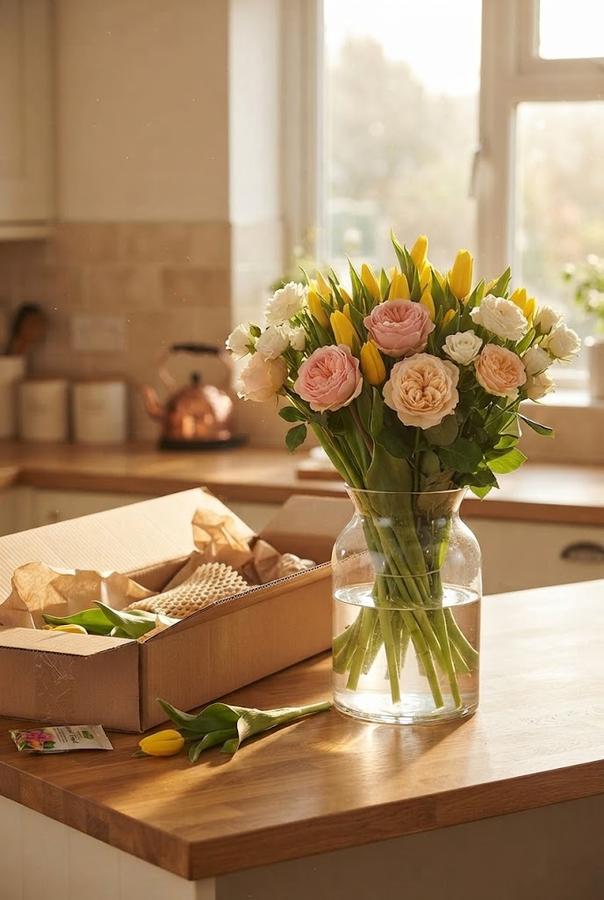
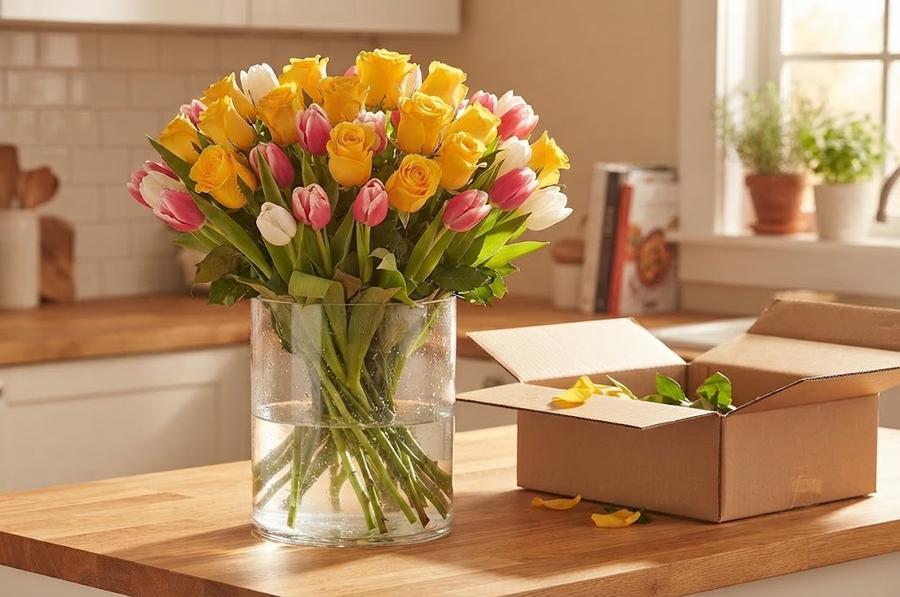
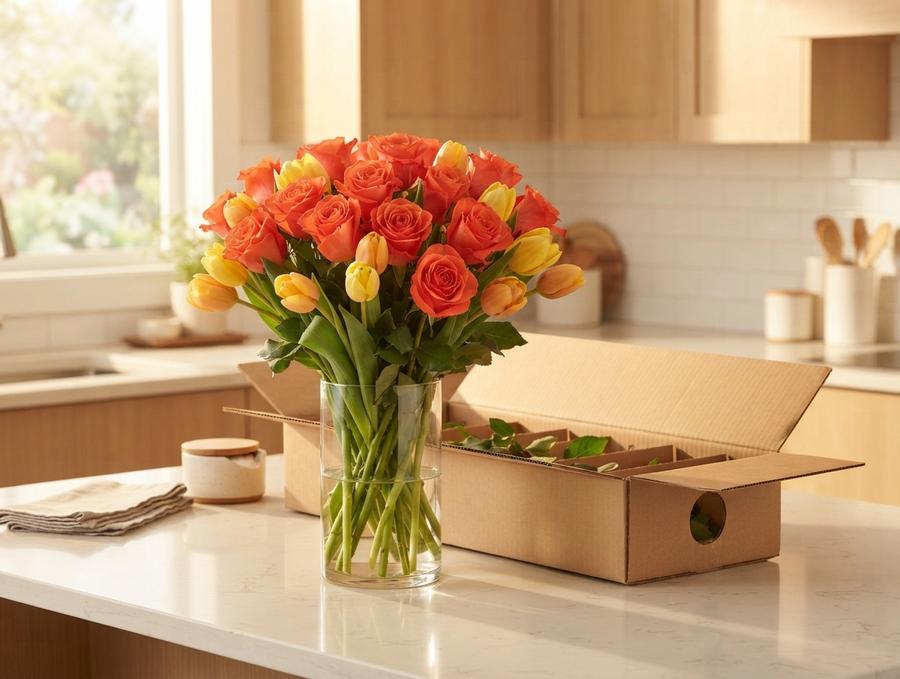
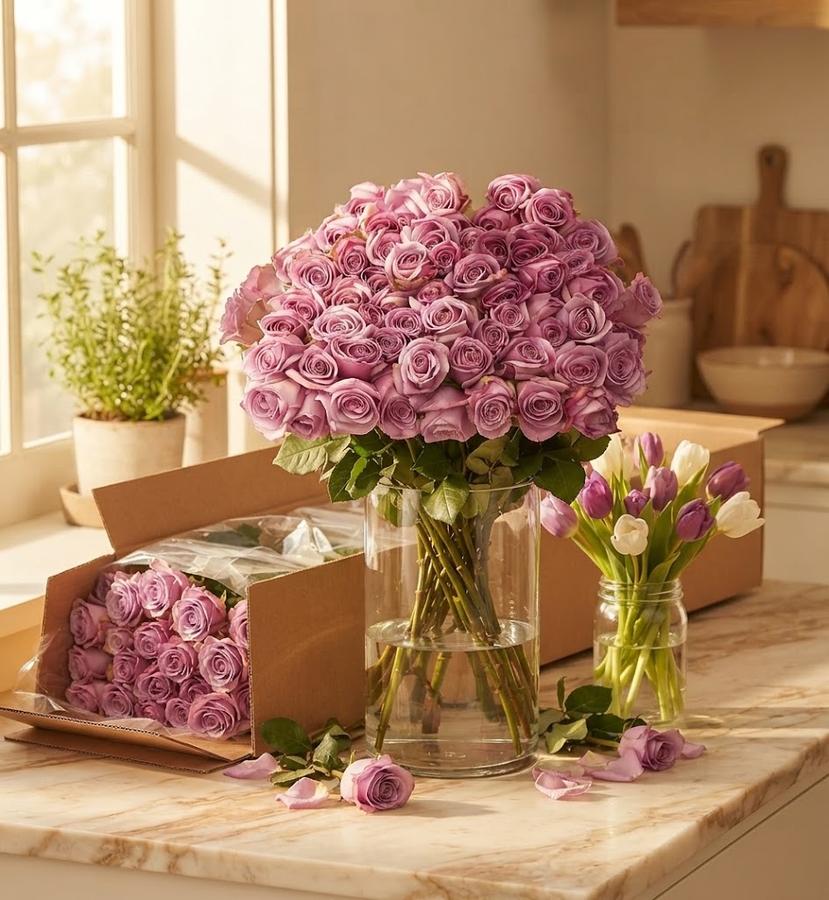
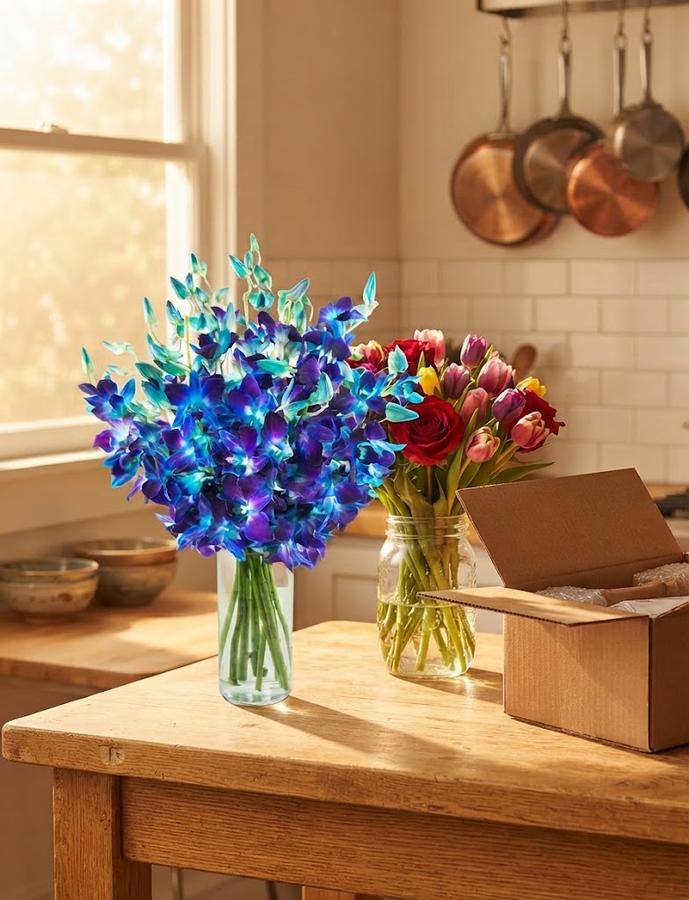
Every bouquet photographed the way it lands: stems out of the sleeve, standing in whatever jar was closest.
Get the Blooms2Door Bouquet Buyer's Guide, plus a reminder before each Valentine's Day and Mother's Day noon cutoff.
No spam. Unsubscribe anytime.
